
As the boom in artificial intelligence is rippling through Silicon Valley, companies up and down the technology stack are trying to take their share. Regardless of who comes out on top, the humble San Jose hardware maker Supermicro is going to take a portion of each AI dollar spent.
Legally known as Super Micro Computer Inc., the three-decade-old business designs and builds the servers and equipment headed for data centers that are necessary to make and operate powerful new generative AI tools such as ChatGPT. The company partners with chipmakers such as Nvidia Corp., Advanced Micro Devices Inc. and Intel Corp. and transforms their products into usable systems that tech companies can deploy to power AI.
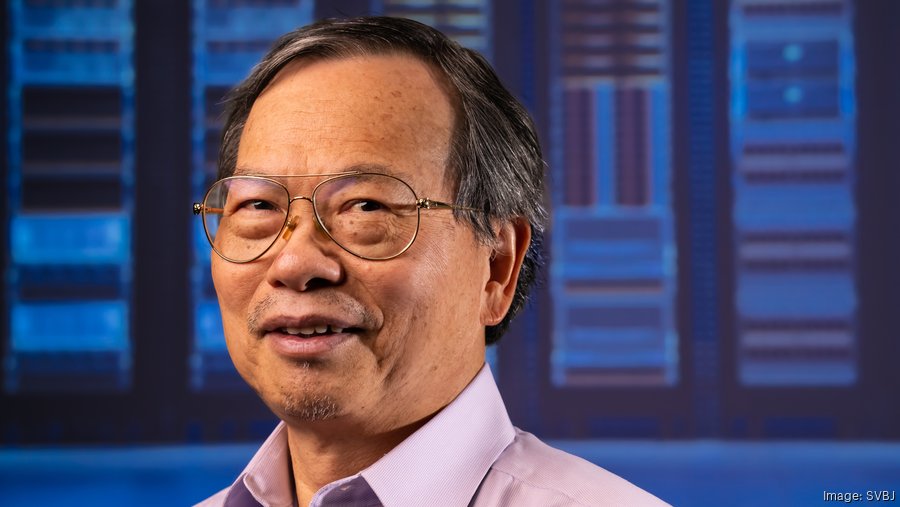
It’s a booming business at the moment, and to hear Supermicro CEO Charles Liang tell it that boom isn’t going to turn bust anytime soon.
“There is lots of room to grow,” Liang said in an interview at the company’s headquarters. “People need more AI chips, and much more powerful (chips), more computing power.”
Supermicro is clearly doing something right. Its share price (Nasdaq: SMCI) has soared roughly 400% in the past year — with about half of those gains arriving just since May — on the back of strong earnings and a bullish forecast.
The company’s stock price now trades for around $240 a piece. Its shares have tended to jump whenever the market perceives a boost in demand for AI chips, whether from Nvidia or its rivals.
But the stock market is also responding to Supermicro’s own and actual success. Last year, its profit more than doubled to $285.1 million, while its revenue jumped 46% to $5.2 billion.
Liang expects the good times to continue, in part because the total market in which it operates — which includes not just servers, but high-end gaming and workstation PCs, networking switches and motherboards — continues to grow, and his company has a relatively small share of it. Supermicro will post around $7 billion in sales in its current fiscal year, which ends this month, he said. But the total market it competes in is between $200 billion and $300 billion, he said.
Even so, Supermicro is making its presence felt in the industry. In the server market alone — which was worth $117.7 billion last year and grew by 20% year-over-year — it was the fifth largest player, according to IDC. Although it trailed behind The Hewlett Packard Enterprise Co. and Dell Inc., its share grew 80% from 2021, according to IDC.
One of the few founders left
Liang is something of a character. He founded Supermicro in 1993 — the same year as Nvidia — and has been running it ever since. He speaks with apparent pride about what the company has accomplished in Silicon Valley, boasting about its technological feats in the early 2000s. He’s also proud of his philanthropic effort — dubbed the Green Earth Foundation — to plant trees in the Sahara Desert to help pull carbon out of the atmosphere.
“It’s the only place that would let me plant them,” Liang said, laughing.
His foundation is a passion project. But the concern it reflects about the environment also underlies one of Supermicro’s most important business strategies: to build server systems that are as energy efficient as possible.
Liang says the 2004 film “The Day After Tomorrow” sparked the idea to make green computers. After seeing the film, his kids challenged him to figure out a way to reduce energy consumption. After turning the idea over in his mind, he realized that if he could build systems that use less power, it could be enormously beneficial to his business, he recalled.
Part of that strategy involved Supermicro making its own power supplies for its servers, rather than buying them from other companies.
“I took out the calculator right away and found we can save about $700 per system each year,” he said.
At the time the energy savings themselves were important. They’re even more so now, given how much power generative AI systems consume.
Building the software underlying ChatGPT required so much energy that it produced nearly 28 times the amount of carbon the typical American generates in a year and many times what a car produces over its lifetime, including the fuel it consumes, according to a recent Stanford study.
Supermicro still designs and builds its own power supply systems for its various machines. The company has about 200 engineers that are solely focused on making those power supply systems as efficient as possible, Liang estimated.
Supermicro’s future in San Jose
The high cost of living in the Bay Area has become a challenge for everyone, including Supermicro, Liang says. So his company — as well as many of its rivals — has moved production overseas to save on costs.
“It’s a big, big challenge for everyone,” he said.
Roughly a decade ago, Supermicro expanded to Taiwan to develop a high-volume manufacturing site, in case there was for it. By contrast, its San Jose manufacturing site now focuses on niche products — the most advanced designs that power the most cutting-edge applications.
“We focus on a modularized design that helps us in terms of faster time to market,” Liang said.
But Liang continues to see benefits to operating Supermicro’s flagship manufacturing facility in Silicon Valley.
One advantage is the close proximity to universities such as San Jose State. Students and recent graduates provide an educated, eager workforce to build systems (Liang says the his company offers salaries are high, and that doesn’t hurt either). It also means there’s a pipeline for engineering talent.
Another advantage of being in the heart of Silicon Valley is that being near companies like Nvidia and Intel have led to partnerships that yielded groundbreaking achievements for the company. Surrounded by all kinds of software businesses gives Supermicro an earlier look at promising new technologies and a chance to develop its own systems to help power them.
“I like San Jose, and most of our people like San Jose,” he said. “Nobody wants to move away — we’re growing so much.”
Comments