
written by Lyle Smith February 27, 2024
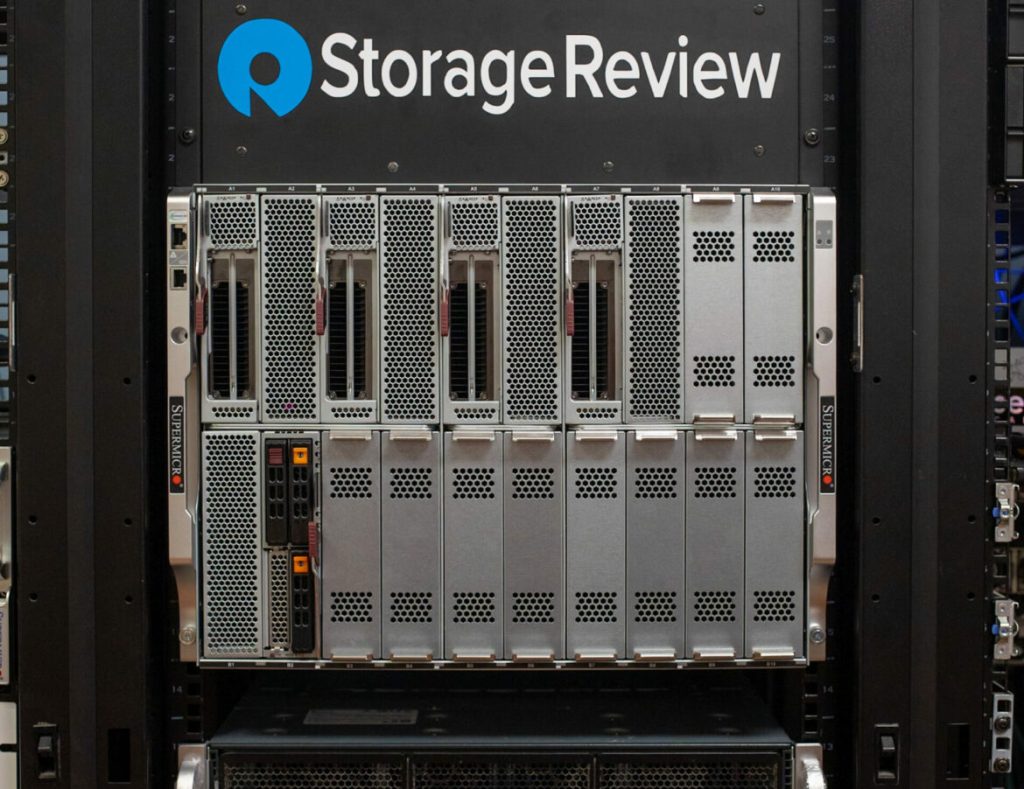
Following our comprehensive review of the Supermicro X13 SuperBlade chassis, we now focus on a server option when populating the chassis, the Supermicro Blade SBI-421E-5T3N. This blade is built around the MBD-B13DET motherboard and is engineered for enterprise data centers, cloud computing, and high-performance computing. When populated alongside other blades inside the X13 chassis, it offers excellent density and efficiency and can house up to 50 servers per 42U rack.
Supermicro blade servers, like the SBI-421E-5T3N, offer a high-density computing solution that enhances server performance while reducing the data center footprint by consolidating multiple server blades into a single chassis. This design shares common resources like power supplies, cooling fans, and networking switches, promoting scalability and flexibility by allowing individual blades to be updated or replaced independently.
The blades can utilize centralized storage and manage networking directly through the chassis, streamlining data access and connectivity within the system. Blades offer a more compact, energy-efficient solution than traditional rack servers, focusing on performance and reliability.
Supermicro Blade SBI-421E-5T3N Components and Build
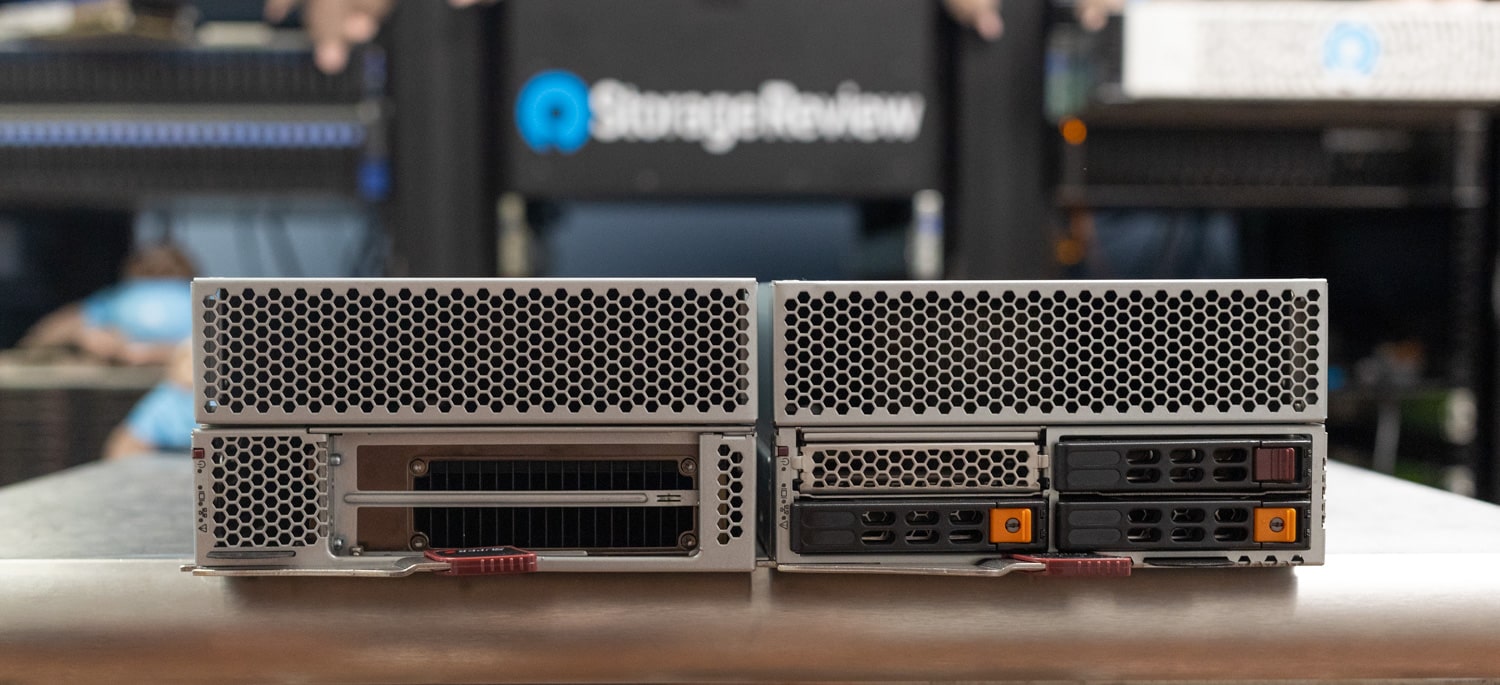
Physically, the blade measures 3.5″ in height, 6.5″ in width, and 23.5″ in depth, weighing 11.5 lbs. The front panel has a power On/Off button, power LED, UID, Network Activity LED, Fault LED, and an SUV (Serial/USB/Video) Connector for ease of use and monitoring.
It is designed with two hot-swap U.2 NVMe/SATA3 drive bays and an additional hot-swap SATA3 drive bay, along with support for one on board M.2 2280 and an optional expansion for four M.2 NVMe via a mezzanine card, catering to a mix of high-speed storage requirements and traditional storage needs.
Moreover, the PCIe Gen5 x16 AIOM (OCP3.0) slot (located at the top slot) in a blade server like the SBI-421E-5T3N SuperBlade is essential for integrating high-speed networking cards and advanced storage solutions, supporting up to 400G network speeds and enabling scalable, efficient data management. This enhances the server’s connectivity and storage capabilities, making it ideal for high-performance computing and data-intensive applications. Along the bottom is the latch lever, which secures the blade in the enclosure with the inconspicuous control panel with status LEDs (Power, UID, Network Activity, Fault) on the right.
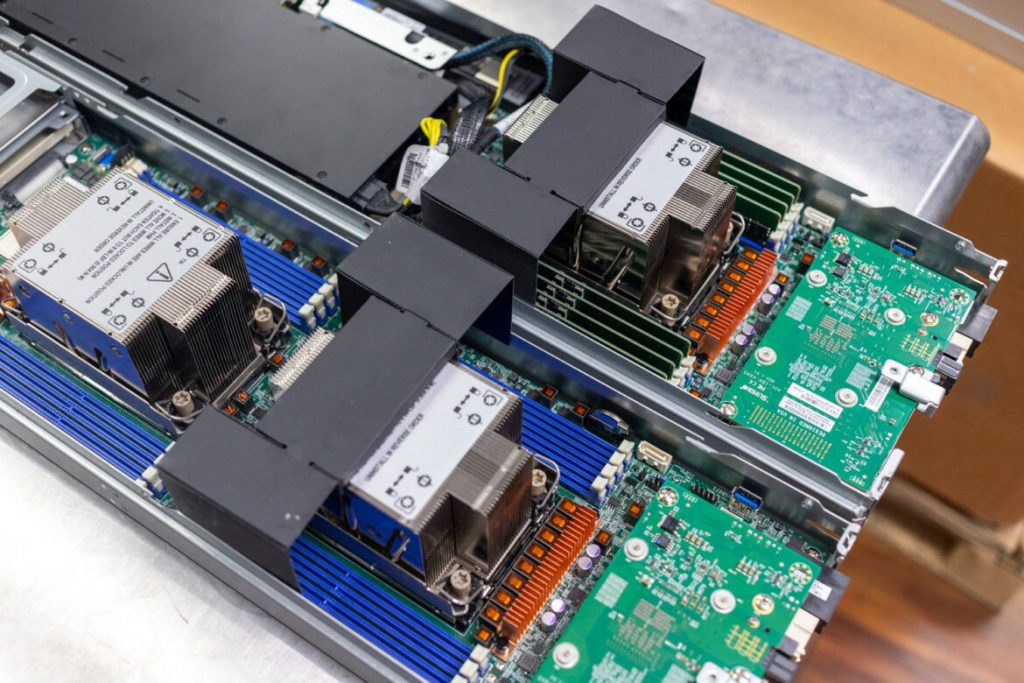
Removing the blade cover involved unscrewing the screw on the side and lifting off the cover. This unveiled a design that is both compact and efficient. The SuperBlade is powered by the MBD-B13DET motherboard, which supports dual Socket E (LGA-4677) configurations. This allows for the integration of either 5th Gen Intel Xeon or 4th Gen Intel Xeon Scalable processors, including the Intel Xeon CPU Max Series with High Bandwidth Memory. As such, it caters to some pretty demanding processing needs. If you need a more GPU-heavy blade configuration, Supermicro has you covered with other models in the 4XXE Superblade line.
This also accommodates CPUs with up to 350W TDP, relying on air cooling for thermal management. This versatility help can help businesses leverage performance for complex computations and data-intensive applications.
The SuperBlade has 16 DDR5 DIMM slots (four on each side of the dual CPU slots), supporting up to 512GB of 5600MHz ECC RDIMM memory in a 1DPC configuration. Our test SuperBlade is equipped with two CPUs providing support for up to 1TB of memory. This substantial memory capacity and speed are crucial for quickly handling large datasets and running memory-intensive applications.
Powered by the Intel C741 chipset, the SuperBlade’s onboard features provide essential I/O capabilities, including dual 25G Ethernet for fast networking. Moreover, security and management are streamlined through IPMI 2.0 with KVM over IP, Redfish API, TPM 2.0, signed firmware, and hardware root of trust, ensuring secure and efficient remote server management. The Aspeed AST2600 graphics controller facilitates video output for management and operational tasks.
Comments