
The Supermicro Hyper SuperServer SYS-221H-TN24R is a 2U server designed to cater to the high demands of contemporary computational workloads. This server is engineered to support dual Socket E (LGA-4677) for 5th/4th Gen Intel Xeon Scalable processors, making it an excellent choice for intensive tasks like virtualization, AI inference, and cloud computing.
Initially, we utilized the SYS-221H-TN24R for the Intel 5th Gen CPU review. Its performance was noteworthy, prompting a more detailed examination and an expansion of storage configurations in our performance section to provide a comprehensive understanding of its capabilities.
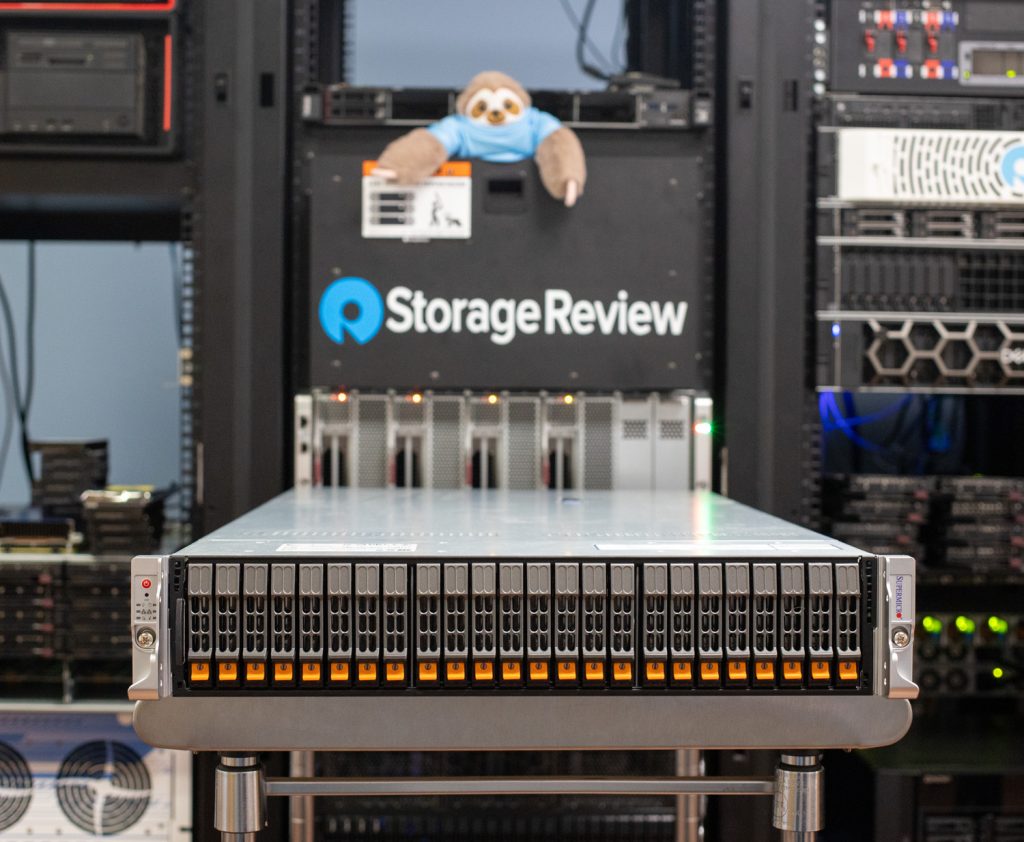
Under the hood, the SYS-221H-TN24R boasts up to 32 DIMM slots supporting an impressive 8TB of memory, with RDIMMs up to DDR5-5600. This massive memory support, coupled with the latest generation of Intel Xeon processors, ensures rapid processing and smooth multitasking. Storage is equally flexible and robust, with 24 hot-swap NVMe/SATA/SAS drive bays and two internal M.2 NVMe/SATA slots, providing a plethora of options for storage configurations and enhancements.
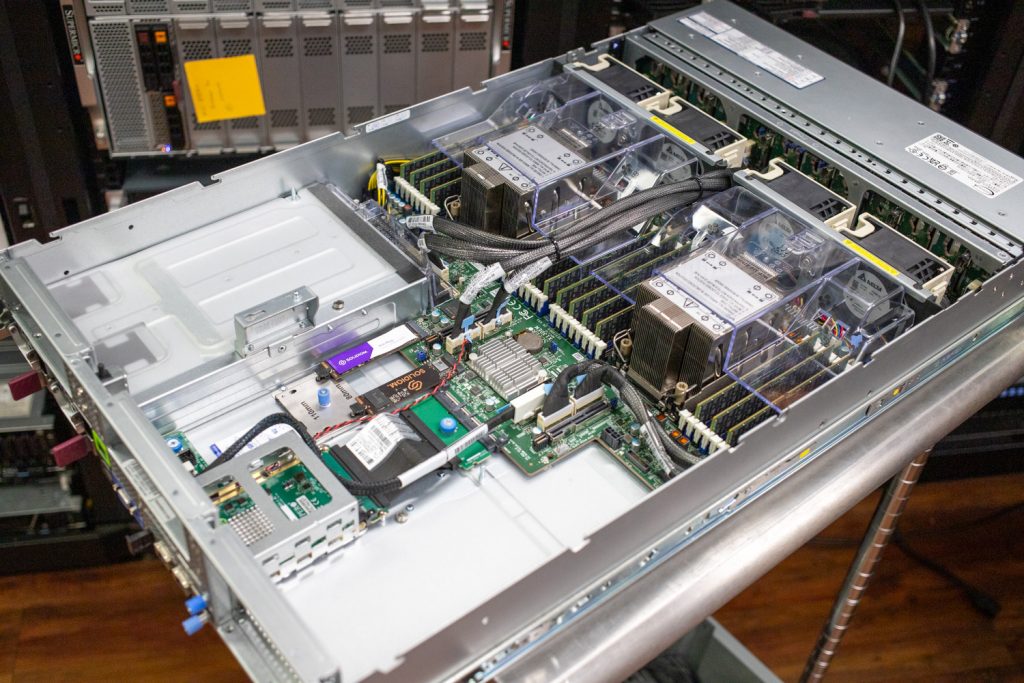
Networking and expansion options include up to two AIOM networking slots compatible with OCP NIC 3.0 and optional PCIe slot configurations of up to eight PCIe 5.0 x8 or four PCIe 5.0 x16 slots. These slots can support double-width GPU/Accelerator cards, making the server suitable for graphics-intensive applications and high-performance computing. For GPU support, it accommodates up to 4 double-width or single-width GPUs, connected via PCIe 5.0 x16 CPU-to-GPU interconnects, enhancing its capability in handling AI and machine learning workloads.
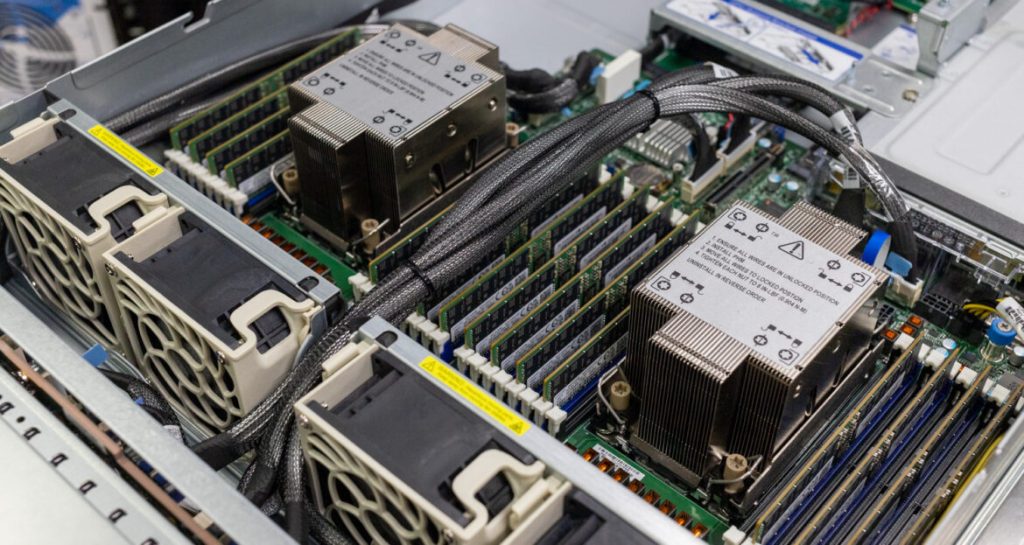
Security and management are top priorities for the Hyper SuperServer SYS-221H-TN24R. It includes features like Trusted Platform Module (TPM) 2.0, secure boot, and firmware updates, among others, ensuring a secure and reliable server environment. In addition, it’s equipped with IPMI 2.0 with virtual media over LAN and KVM-over-LAN support, allowing for easy remote management. Comprehensive PC health monitoring is also included, tracking CPU, fans, temperature, and other crucial components to maintain optimal performance.
Supermicro Hyper SuperServer SYS-221H-TN24R Specifications
| SKU | Supermicro Hyper SuperServer SYS-221H-TN24R |
| Motherboard | Super X13DEM |
| Processor | |
| CPU | Dual Socket E (LGA-4677)5th Gen Intel Xeon / 4th Gen Intel Xeon Scalable processorsSupports Intel Xeon CPU Max Series with high bandwidth memory (HBM) |
| Core Count | Up to 64C/128T; Up to 320MB Cache per CPU |
| Note | Supports up to 350W TDP CPUs (Air Cooled)Supports up to 350W TDP CPUs (Liquid Cooled) |
| GPU | |
| Max GPU Count | Up to 4 double-width or 4 single-width GPU(s) |
| Supported GPU | NVIDIA PCIe: L40S,RTX A2000,A100 |
| CPU-GPU Interconnect | PCIe 5.0 x16 CPU-to-GPU Interconnect |
| GPU-GPU Interconnect | PCIe |
| System Memory | |
| Memory | Slot Count: 32 DIMM slotsMax Memory (1DPC): Up to 4TB 5600MT/s ECC DDR5 RDIMMMax Memory (2DPC): Up to 8TB 4400MT/s ECC DDR5 RDIMMView Memory Options |
| Memory Voltage | 1.1 V |
| On-Board Devices | |
| SATA | SATA3 (6Gbps); RAID 0/1/5/10 support |
| NVMe | NVMe; RAID 0/1/5/10 support (Intel® VROC RAID Key required)View NVMe Options |
| Chipset | Intel® C741 |
| Network Connectivity | 2x 1GbE BaseT with Intel i350-AM2 (optional)4x 1GbE BaseT or 4x 1GbE SFP with Intel® i350-AM4 (optional)2x 10GbE BaseT with Intel X550-AT2 (optional)2x 10GbE SFP+ with Intel X710-BM2 (optional)4x 10GbE SFP+ with Intel XL710-BM1 (optional)4x 10GbE RJ45/SFP+ with Intel X710-TM4 (optional)2x 25GbE SFP28 with Broadcom BCM57414 (optional)4x 25GbE RJ45/SFP28 with Mellanox CX-4 Lx EN Intel X550-AT2 (optional)2x 100GbE QSFP28 with Broadcom BCM57508 (optional) |
| IPMI | Support for Intelligent Platform Management Interface v.2.0IPMI 2.0 with virtual media over LAN and KVM-over-LAN support |
| Input / Output | |
| LAN | 1 RJ45 Dedicated BMC LAN port |
| USB | 2 USB 2.0 port(s) (2 rear) |
| Video | 1 VGA port(s) |
| System BIOS | |
| BIOS Type | AMI 256MB SPI Flash |
| Management | |
| Software | IPMI 2.0KVM with dedicated LANSuper Diagnostics Offline SuperDoctor 5Supermicro Update Manager (SUM)Supermicro Power Manager (SPM)Supermicro Server Manager (SSM)Redfish API |
| Power Configurations | Power-on mode for AC power recoveryACPI Power Management |
| Security | |
| Hardware | Trusted Platform Module (TPM) 2.0Silicon Root of Trust (RoT) – NIST 800-193 Compliant |
| Features | Cryptographically Signed FirmwareSecure BootSecure Firmware UpdatesAutomatic Firmware RecoverySupply Chain Security: Remote AttestationRuntime BMC ProtectionsSystem Lockdown |
| PC Health Monitoring | |
| CPU | Monitors for CPU Cores, Chipset Voltages, Memory |
| FAN | Fans with tachometer monitoringPulse Width Modulated (PWM) fan connectorsStatus monitor for speed control |
| Temperature | Monitoring for CPU and chassis environmentThermal Control for fan connectors |
| Chassis | |
| Form Factor | 2U Rackmount |
| Model | CSE-HS219-R1K63P |
| Dimensions and Weight | |
| Height | 3.5″ (88.9mm) |
| Width | 17.2″ (437mm) |
| Depth | 29.9″ (760mm) |
| Package | 10.4″ (H) x 23.8″ (W) x 43.6″ (D) |
| Weight | Net Weight: 40 lbs (18.2 kg)Gross Weight: 66 lbs (30 kg) |
| Available Color | N/A |
| Front Panel | |
| Buttons | Power On/OffUID button |
| LEDs | HDD activityLAN1 activityPowerSystem information |
| Expansion Slots | |
| PCI-Express (PCIe) | 4 (Optional) PCIe 5.0 x16 or x8 FH, 10.5″L slot(s)4 (Optional) PCIe 5.0 x8 FH, 10.5″L slot(s)View AOC Options |
| Note | For 16 NVMe configurations, PCIe slots 1,2 and AIOM slot A2 cannot be used.For 24 NVMe configurations, PCIe slots 1,2,5,6 and AIOM slot A2 cannot be used. |
| Drive Bays / Storage | |
| Hot-swap | 24x 2.5″ hot-swap NVMe/SATA/SAS drive bays (NVMe, SATA, or SAS support requires additional parts. Please see the Optional Parts list.)View Drive Options |
| M.2 | 2 M.2 NVMe OR 2 M.2 SATA3M-Key, 2280/2210 |
| System Cooling | |
| Fans | 4x 8cm heavy-duty fans with optimal fan speed control |
| Air Shroud | 2 Air Shroud(s) |
| Liquid Cooling | Direct to Chip (D2C) Cold Plate (optional) |
| Power Supply | |
| 2x 1600W Redundant Titanium Level power supplies | |
| Dimension(W x H x L) | 73.5 x 40 x 265 mm |
| AC Input | 1000W: 100-127Vac / 50-60Hz1600W: 200-240Vac / 50-60Hz1600W: 200-240Vdc / 50-60Hz (for CQC only) |
| +12V | Max: 83.3A / Min: 0A (100Vac-127Vac)Max: 133.3A / Min: 0A (200Vac-240Vac) |
| 12V SB | Max: 3.5A |
| Output Type | Backplanes (gold finger) |
| Operating Environment | |
| Environmental Spec. | Operating Temperature: 10°C ~ 35°C (50°F ~ 95°F)Non-operating Temperature: -40°C to 70°C (-40°F to 158°F)Operating Relative Humidity: 8% to 90% (non-condensing)Non-operating Relative Humidity: 5% to 95% (non-condensing) |
| Environmental / Recycling | |
| Recycle | Return Server-End of Life Product |
Supermicro Hyper SuperServer SYS-221H-TN24R Design and Build
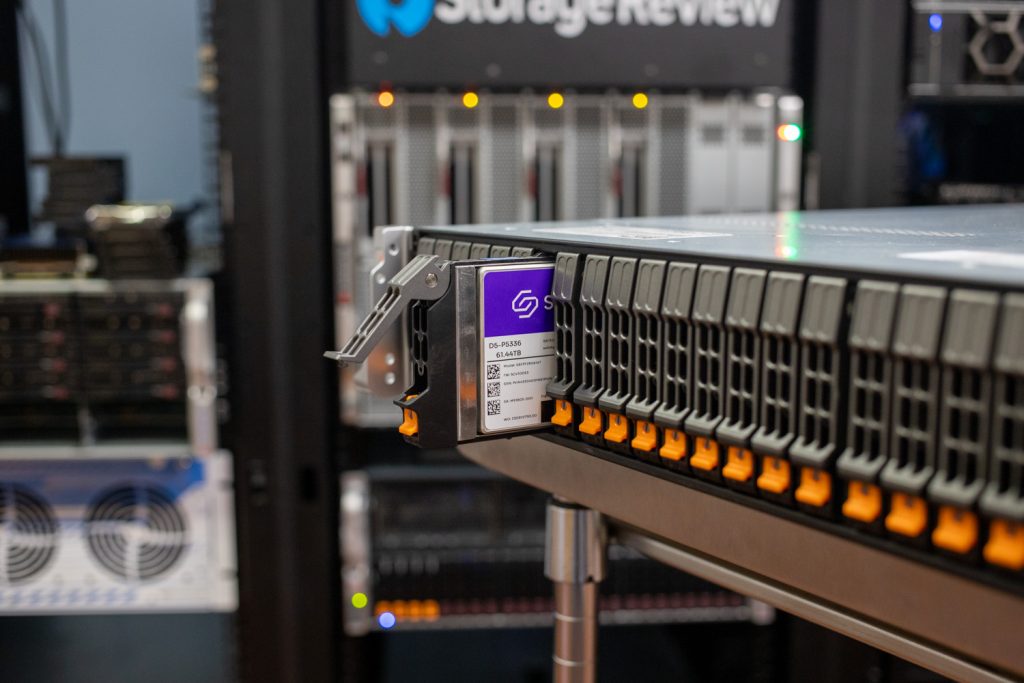
The Hyper SuperServer SYS-221H-TN24R’s design and construction are meticulously engineered for ease of maintenance and long-lasting durability. Central to its design are the 24 front-accessible hot-swap 2.5″ drive bays, compatible with NVMe, SATA3, and SAS3 drives. These bays offer convenient, tool-free access (this is very nice, no more caddy screws), allowing for quick and easy drive replacements or upgrades. The server’s front panel is also thoughtfully laid out, featuring a range of LED indicators for system status (including Power, Power Fail, NIC1/2, HDD, and Information), alongside a UID button and a Power button for straightforward control.
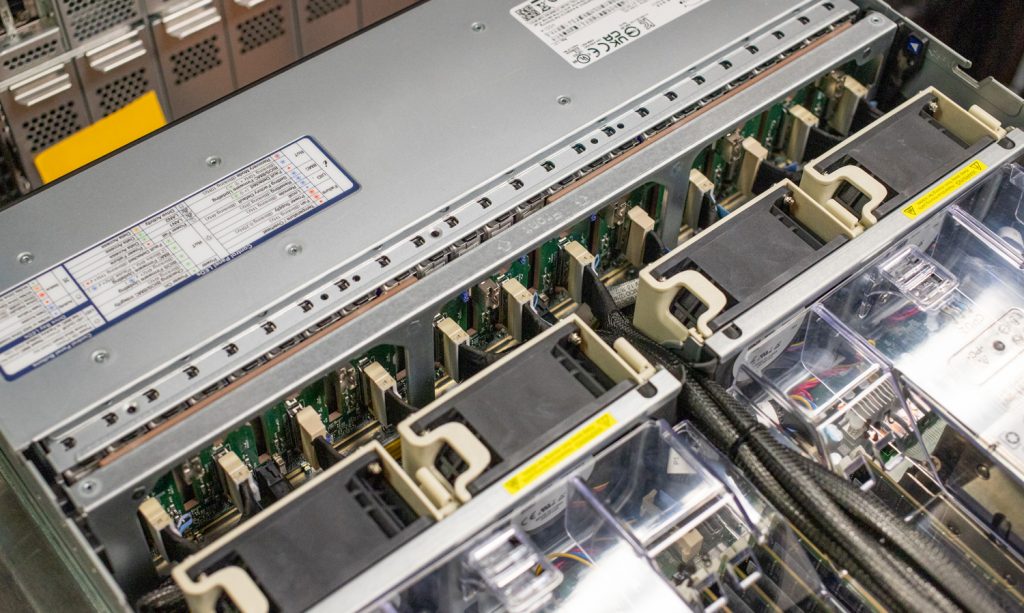
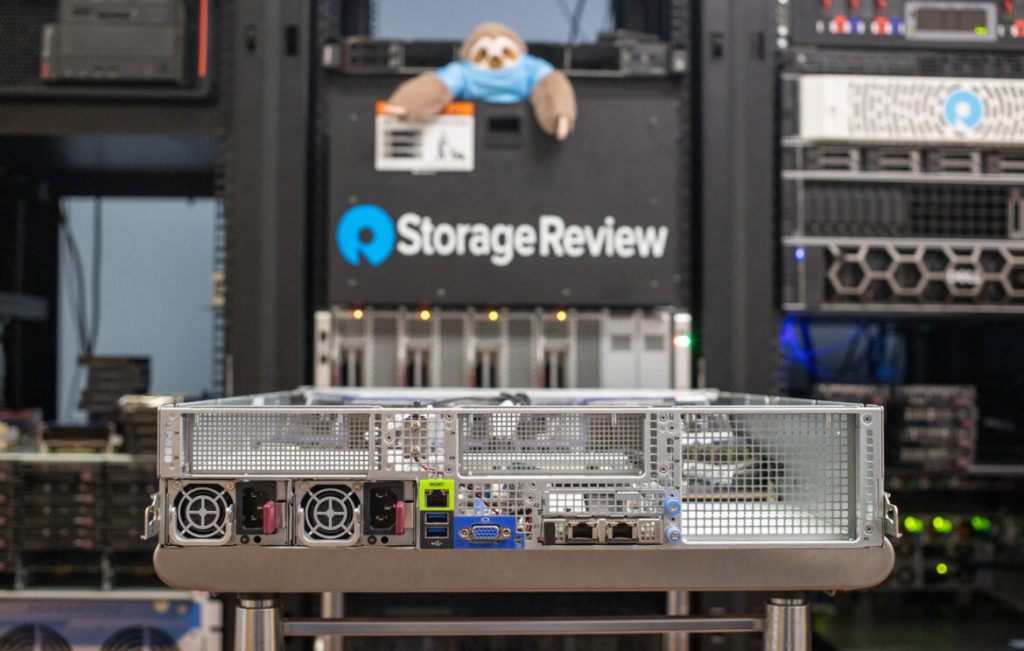
At the rear, the server is equipped with dual 1600W Titanium Level power supply units, providing redundant, high-efficiency power to ensure consistent operation without interruption. These units are easily removable for maintenance, thanks to their practical pull handles. Adjacent to these are essential connectivity ports: two USB 2.0 ports, a dedicated RJ45 BMC LAN port for management, and a VGA port for local console access. The server also includes an AIOM/OCP NIC 3.0 slot and an optional secondary slot for network expansion, alongside eight customizable PCIe 5.0 x8/x16 slots, offering ample space for additional cards and components. Clearly, our review sample did not get the PCIe slots, we just have the three blanking panels.
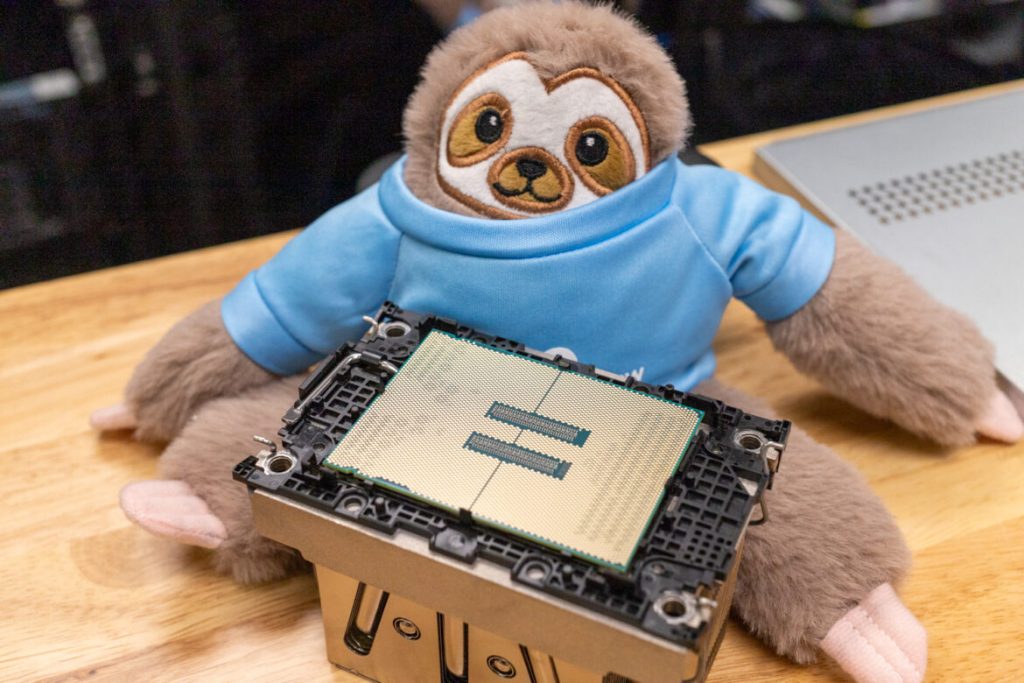
Accessing the internal components is straightforward, requiring only the release of a button to remove the top cover. Inside, a spacious layout is evident, simplifying the installation and removal of components. The server houses two CPU sockets, compatible with 4th/5th Gen Intel Xeon Scalable Processors, supporting four UPIs (16 GT/s max) and CPUs with a TDP of up to 350W. Encircling these sockets are 32 DIMM memory slots, positioned for optimal accessibility and airflow.
Cooling in the SYS-221H-TN24R is handled efficiently by four 8-cm dual counter-rotating PWM fans (FAN-0223L4), placed to provide maximum airflow over the CPUs and memory. The drive bays at the front are neatly organized, each directly connected to a comprehensive backplane for streamlined data management. Additionally, the chassis supports an optional Direct to Chip (D2C) Cold Plate liquid cooling solution, enhancing its capability to handle high thermal loads while maintaining system stability and performance.
Overall, the build and design of the SYS-221H-TN24R reflect Supermicro’s commitment to creating servers that are not only powerful and efficient but also user-friendly and adaptable to future upgrades and maintenance needs.
KVM management
To explore the advanced capabilities of the SYS-221H-TN24R, we’ll look at the remote management interface. This offers a window into the server’s operational status, providing real-time monitoring and management features that are crucial for ensuring peak performance and prompt maintenance responses.
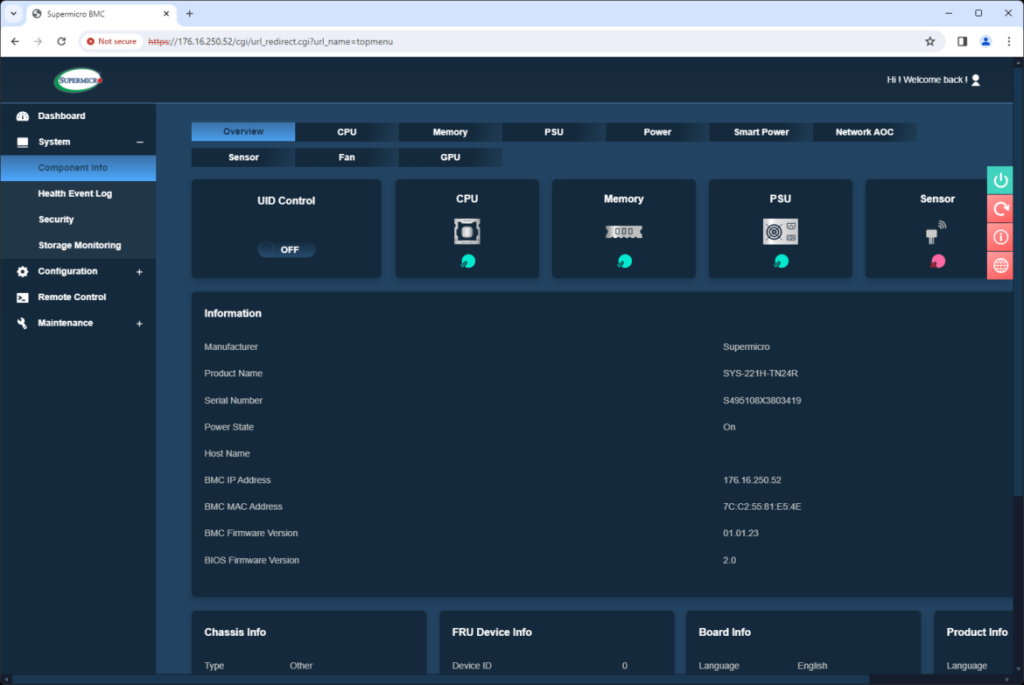
For example, the Overview includes UID (Unit Identification) control and general information about the server. It provides the manufacturer name, product name, serial number, power state, hostname, and network information including BMC IP and MAC addresses. UID control is typically used to visually identify the server in a rack with a blinking LED. Moreover, the firmware versions for both the BMC and BIOS are also displayed for useful at-a-glance information, making this a useful area for inventory management and troubleshooting.
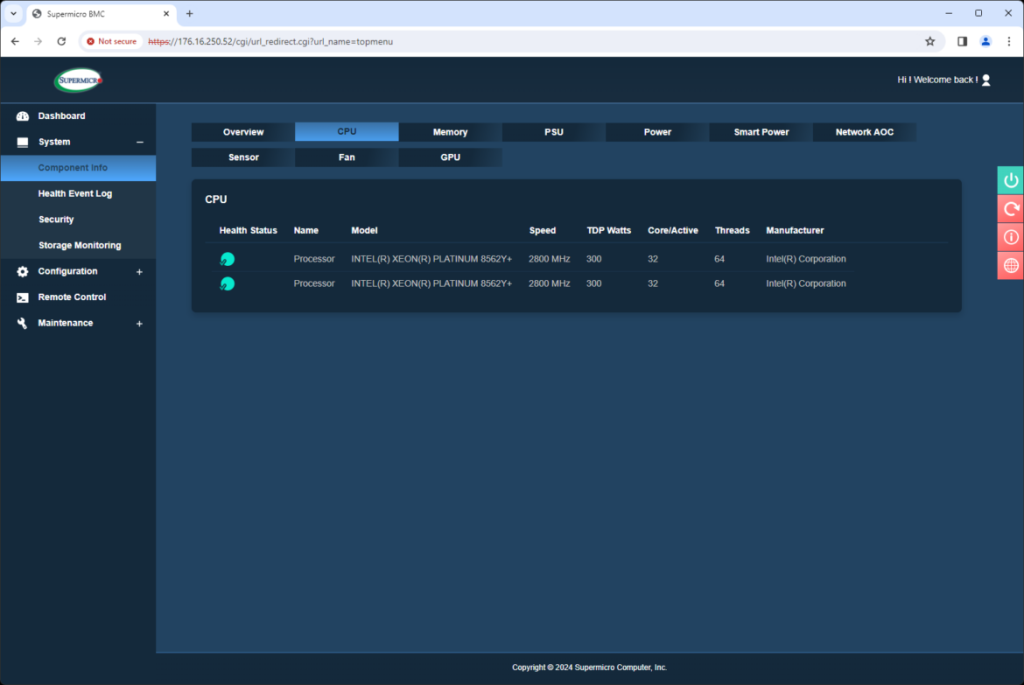
The CPU section lists the health status, model, speed, Thermal Design Power (TDP) watts, core count, thread count, and manufacturer of the installed CPUs. In this case, it shows two Intel Xeon Platinum 8562Y+ processors, each with 32 cores and 64 threads, running at 2800 MHz and a TDP of 300 watts.
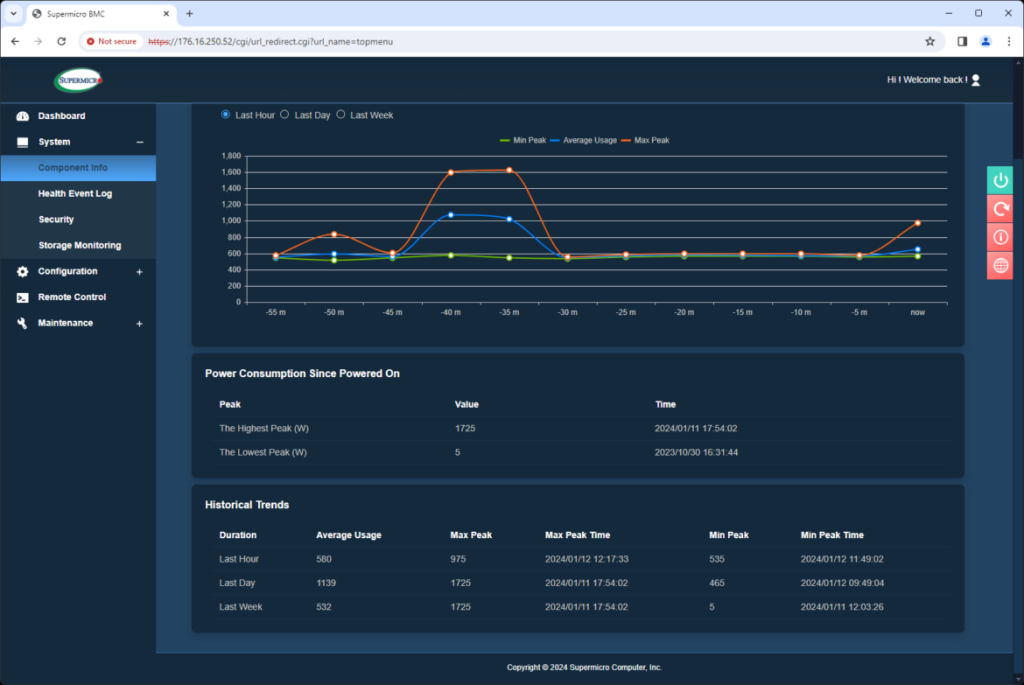
The power consumption area provides real-time and historical data on the power usage of the server. As shown in the image below, it displays minimum, average, and maximum power consumption over the last hour, and below the graph is a summary of power consumption since the server was powered on. This includes peak values and their corresponding times. Additionally, it also provides users with historical trends for the last hour, day, and week are presented, detailing average usage, maximum peak, and minimum peak power consumption.
This information is super useful for those looking to manage their system’s power efficiency as well as to ensure that the server operates within its power capacity.
Supermicro Hyper SuperServer SYS-221H-TN24R Performance
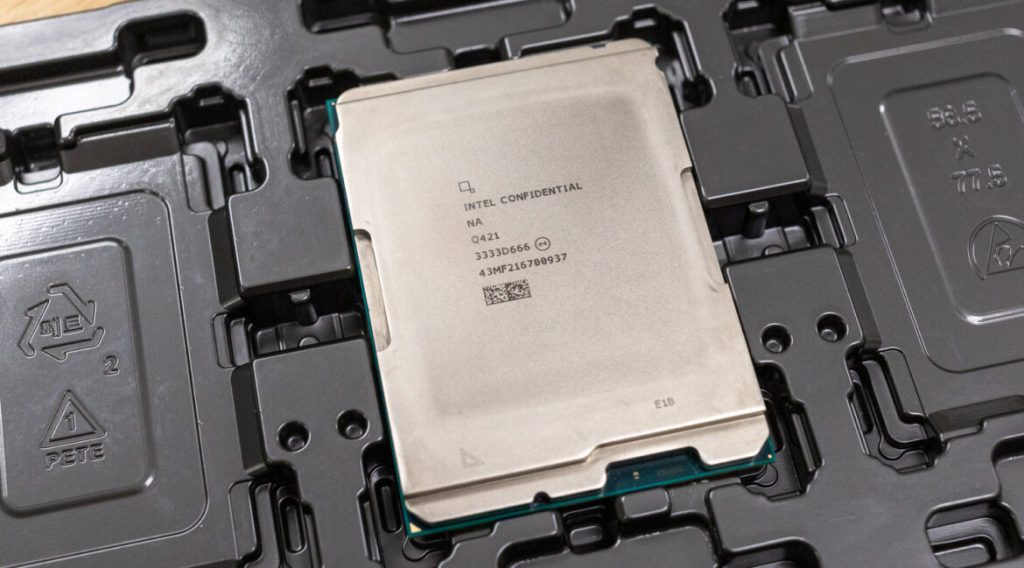
We continue to leverage the performance results from our initial examination of the 5th Gen Intel Xeon Scalable Processors. Our focus is on the SYS-221H-TN24R system, powered by two 8562Y+ processors. This setup will be benchmarked against our E1.S Supermicro platform, just as a reference point, which is equipped with two 8460H CPUs.
Supermicro Hyper SuperServer SYS-221H-TN24R Specifications
- 2 x Intel Xeon Platinum 8562Y+ CPUs
- 512GB DDR5
- Windows Server 2022
Supermicro Storage SuperServer SSG-121E-NES24R Specifications
- 2 x Intel Xeon Platinum 8460H CPUs
- 512GB DDR5
- Windows Server 2022
The Intel Xeon Platinum 8562Y and 8460H, belonging to the 5th and 4th generations of Intel Xeon Scalable Processors respectively, exhibit notable differences. The 8562Y+ operates at a base frequency of 2.80 GHz and offers 32 cores with 64 threads, contrasting with the 8460H’s 40 cores and 64 threads at a 2.2 GHz base frequency.
The 8460H also stands out with a significantly larger 105 MB cache, compared to the 60 MB of the 8562Y+, which could be advantageous in applications requiring extensive data processing. Both models support DDR5 memory. However, the 8460H is less energy-efficient, with a TDP of 330W against the 300W of the 8562Y+. In terms of pricing, the 8460H is notably more expensive, listed at over $10,000, while the 8562Y+ is priced at just under $6,000.
To provide a comprehensive performance analysis, our benchmarks encompass a variety of intensive tests, each targeting different aspects of CPU performance. We’ll use Blender OptiX for rendering performance, Blackmagic to assess video processing capabilities, and Geekbench for overall system performance evaluation. Moreover, Cinebench will give us insights into graphics and rendering efficiency, y-cruncher for mathematical computations, and 7-Zip compression tests to gauge data processing and compression speeds.
These diverse benchmarks will help give us a well-rounded assessment, covering both general and specialized computing tasks to see how they fare in real-world scenarios.
Blender OptiX
First up is the Blender test—an open-source 3D modeling application. This benchmark was run using the Blender Benchmark utility. The score is samples per minute, with higher being better.
In version 4.0 of Blender, here are the scores of both Intel CPUs:
| Blender 4.0 CPU | 2 x 32-core Platinum 8562Y+ | 2x 40-core Platinum 8460H |
| Monster | 805.254137 | 671.717058 |
| Junkshop | 513.800608 | 424.825295 |
| Classroom | 414.999628 | 347.791937 |
Blackmagic RAW Speed Test
We have also started running Blackmagic’s RAW speed test, which tests video playback performance. Additionally, this test is more of a hybrid test pooling both CPU and GPU in a Real-World scenario for RAW decoding.
| Blackmagic RAW Speed Test | 2 x 32-core Platinum 8562Y+ | 2x 40-core Platinum 8460H |
| 8k CPU | 175 FPS | 145 FPS |
Geekbench 6
Geekbench 6 is a cross-platform benchmark that measures overall system performance. However, looking at the single-core vs. multi-core and the OpenCL benchmark would be interesting. Higher scores are better. Again, we only looked at the CPU results, as no GPU are installed inside either server.
| Geek Bench 6 | 2 x 32-core Platinum 8562Y+ | 2x 40-core Platinum 8460H |
| Single Core | 2,149 | 1,111 |
| Multi Core | 22,494 | 8,589 |
You can find comparisons to any system you want in the Geekbench Browser.
Cinebench R23
Maxon’s Cinebench R23 is a CPU rendering benchmark that utilizes all CPU cores and threads. We ran it for both multi- and single-core tests. Higher scores are better.
| Cinebench R23 | 2 x 32-core Platinum 8562Y+ | 2x 40-core Platinum 8460H |
| CPU Multi Core | 103,848 | 75,720 |
| CP Single Core | 1,500 | 1,068 |
| MP Ratio | 69.25x | 70.92x |
Cinebench 2024
Here are the results for the 2024 version of Cinebench, looking at the CPU.
| Cinebench R24 | 2 x 32-core Platinum 8562Y+ | 2x 40-core Platinum 8460H |
| CPU Multi Core | 5,289 | 4,243 |
| CP Single Core | 82 | 62 |
| MP Ratio | 62.1 | 68.52 |
y-cruncher
y-cruncher is a multi-threaded and scalable program that can compute Pi and other mathematical constants to trillions of digits. Since its launch in 2009, y-cruncher has become a popular benchmarking and stress-testing application for overclockers and hardware enthusiasts. Faster is better in this test.
| y-cruncher | 2 x 32-core Platinum 8562Y+ | 2x 40-core Platinum 8460H |
| 50 Billion | 363.758 seconds | N/A |
| 25 Billion | 164.066 seconds | 191.909 seconds |
| 10 Billion | 57.868 seconds | 67.484 seconds |
| 5 Billion | 26.934 seconds | 30.813 seconds |
| 2.5 Billion | 12.036 seconds | 14.059 seconds |
| 1 Billion | 4.344 seconds | 5.134 seconds |
Conclusion
The Supermicro Hyper SuperServer SYS-221H-TN24R is designed for high-demand computational workloads, offering support for 5th Gen Xeon Scalable processors and up to 8TB of DDR5 memory. This 2U rack server, capable of handling tasks like virtualization, AI, and cloud computing, is notable for its flexibility and power. The inclusion of 24 hot-swap NVMe/SATA/SAS drive bays and two internal M.2 NVMe/SATA slots provides some pretty extensive storage options, enhancing its overall utility and adaptability in various settings. Its design also emphasizes easy maintenance and comprehensive monitoring of crucial components, ensuring optimal performance.
The server’s networking and expansion capabilities, including AIOM slots and optional PCIe configurations, make it a versatile choice for a range of applications. Moreover, its support for up to four GPUs means it is well-suited for graphics-intensive tasks and high-performance computing, while security features like TPM 2.0, secure boot, and constant firmware updates ensure a secure and reliable server environment. As for its performance results in our various benchmarks, it certainly demonstrated its efficiency in handling demanding tasks, which makes it a strong contender for enterprises in need of a high-performance, scalable server solution.
Ultimately, its NVMe storage configurations, dual processor setup, and diverse expansion options make the SYS-221H-TN24R an ideal solution for businesses seeking a flexible multi-purpose platform to handle the bulk of enterprise applications.
Comments