
The Supermicro SuperBlade systems have been around for quite some time. The popular blade chassis come in a variety of form factors, including 4U, 6U, and 8U. Each size gives customers a different set of choices when ultimately selecting the blades that go inside. In this review, we’re taking a look at the largest Supermicro SuperBlade, the 8U chassis. This behemoth supports 20 blades, sandwiched into the SuperBlade across two rows. This system brings incredibly dense mix-and-match blades to bear on today’s modern applications that are hungry for compute power.
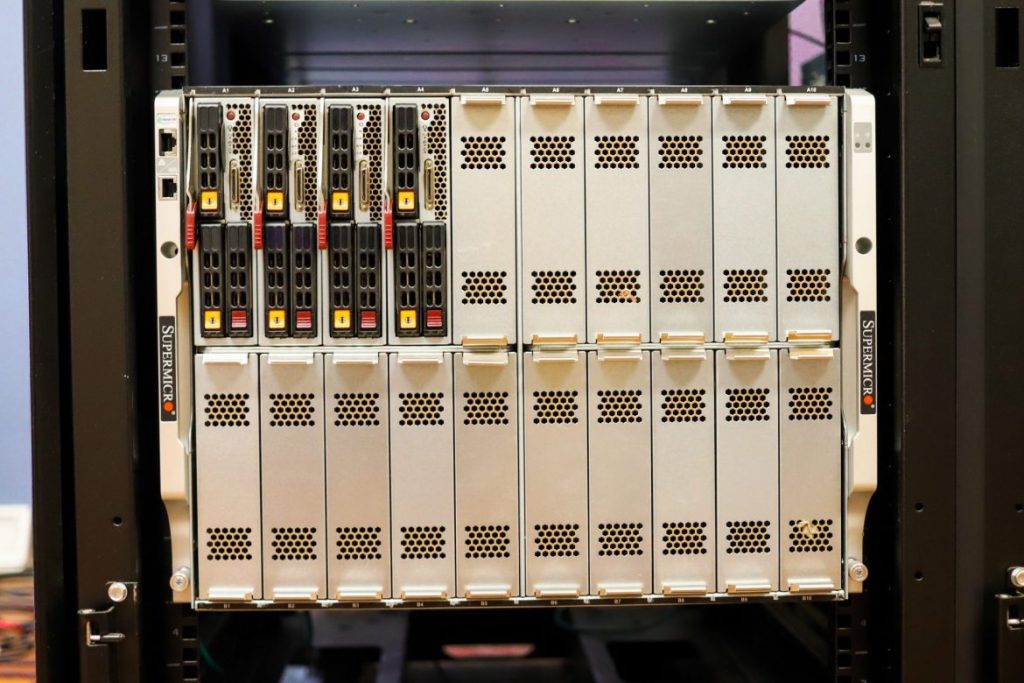
Supermicro SuperBlade vs. MicroBlade
Years ago, we did a review of the MicroBlade solution. Like SuperBlade, MicroBlade has been updated with Gen3 processor compute blades from both Intel and AMD.
While MicroBlades are best suited for high-density, power efficiency, and value-oriented use cases, the SuperBlade is a higher-end platform designed for much more. They are optimized for advanced networking, with 200G InfiniBand options, and can have up to four 25GbE networking ports. SuperBlades also support higher-end CPUs, including 1-socket, 2-socket, and 4-socket Intel Xeon Scalable and 1-socket AMD EPYC Gen 3 processors. You can mix and match AMD and Intel servers as well as use both single and dual-socket CPUs. The MicroBlade, however, only supports 1-socket Intel Xeon E and D processors and is equipped with either 1GbE or 10GbE ports.
Though the SuperBlades don’t have any integrated Fibre Channel switches, they do have Fibre Channel cards they support. SuperBlades can support FC environments (the cabling would come out the front of the server). Some blades have an AIOM card or PCIe Gen4 expansion slot, which can be populated with a fiber channel card, though you would have to connect them to a separate fiber channel switch.
The SuperBlade also supports up to 12TB of memory and consists of both front-accessible/hot-pluggable and internal storage options. The MicroBlade can be outfitted with up to 128GB of memory and only supports internal storage so you users must power down the server to change or add drives.
SuperBlade servers are uniquely designed for specific SuperBlade enclosures, the 4U, 6U or 8U. The MicroBlade servers, on the other hand, can go into either 3U or 6U MicroBlade enclosures.
Supermicro SuperBlade 8U Chassis
Of course, the most fundamental part of this blade offering is the chassis itself. Supermicro sells a few versions of the SuperBlade 8U, depending on the target workloads. They all support the same server blades, the differences come down to the wide array of networking and management options Supermicro offers.
This 8U form factor is the biggest, most flexible of the SuperBlades and is highlighted by its 20 hot-pluggable nodes, optimized performance, and advanced networking (including Omnipath).
That said, for more resource-intensive, mission-critical use cases, Supermicro will direct users to the 6U enclosure as it allows for full-height nodes and therefore can fit the maximum amount of memory (a memory-optimized architecture). The 4U SuperBlade is the value-optimized enclosure, with the highest server node density. It also has the lowest acquisition cost.
The SBI-420P-1T3N is the SATA model of the 420P family, which includes three SATA/NVMe front-facing slots. There’s also a SAS model (SBI-420P-1C2N) and a liquid cooling model that is ordered directly through Supermicro, the latter of which is ideal for HPC customers who need support for higher-end TDP CPUs that are specced above up to 270W. The SBI-420P-1T3N supports up to 220W via air cooling.
The SBI-420P-1T3N also supports dual-onboard 25GbE NICs and a mezzanine connector (PCIe Gen4) in the blade that can give you two additional 25GbE ports for a total of four. There are also mezzanine connectors for 100G EDR and 200G HDR InfiniBand.
Our review enclosure model is the SBE-820J, which is designed for enterprise and Cloud environments while featuring support for four 25GbE switches or Pass-Thru modules. Supermicro’s new Pass-Thru modules are built for customers who want to use switches they already own.
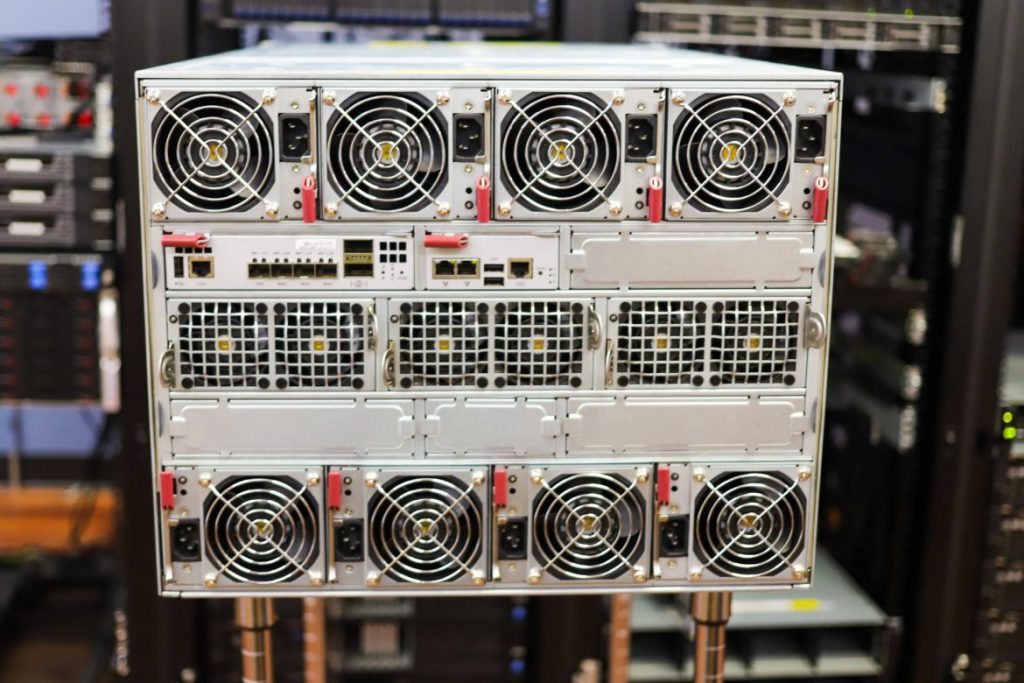
The 820J also comes with (up to) eight power supplies depending on your build and specific needs, each of which has its own integrated fan to help with cooling. For those who have higher-end TDP CPUs, the 820H model can be outfitted with three dual-fan modules (in the middle of the back panel) for additional cooling.
Comments